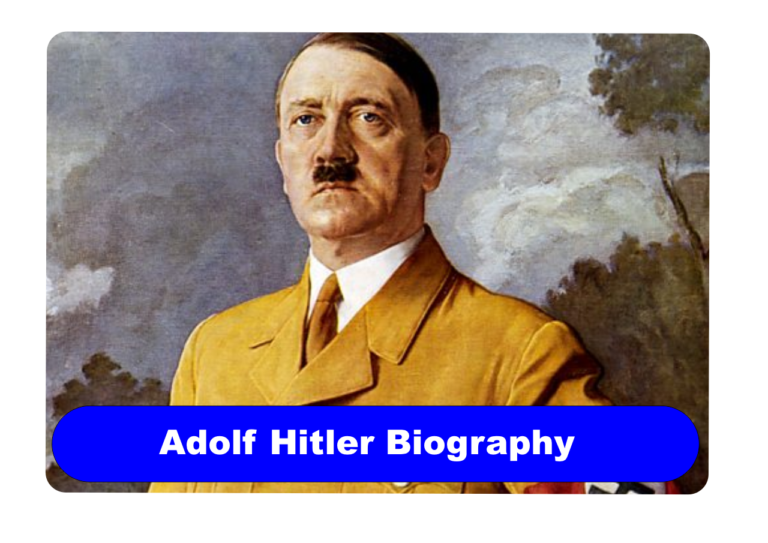
Adolf Hitler ruled Nazi Germany from 1933 to 1945. Explore his age at death, wife Eva Braun, rise to power, World War II and responsibility for the Holocaust.
Adolf Hitler was an Austrian-born German politician and dictator who ruled Nazi Germany from 1933 until his death in 1945. This Adolf Hitler biography explores his early life, education, political career, marriage, and role in World War II. As leader of the Nazi Party, he established a totalitarian dictatorship built on extreme nationalism, antisemitism, racial persecution, and military expansion. His government was responsible for the Holocaust, which resulted in the systematic murder of six million European Jews and the persecution and killing of millions of others.
Born on 20 April 1889 in Austria, Hitler initially wanted to become an artist before entering politics after World War I. He became Germany’s chancellor in 1933 and consolidated dictatorial power the following year. His invasion of Poland in September 1939 triggered World War II in Europe, a conflict that caused tens of millions of deaths. Hitler died by suicide in Berlin on 30 April 1945, aged 56, as Nazi Germany faced military defeat.
Quick Facts About Adolf Hitler
| Detail | Information |
|---|---|
| Full Name | Adolf Hitler |
| Date of Birth | 20 April 1889 |
| Date of Death | 30 April 1945 |
| Age at Death | 56 years |
| Birthplace | Braunau am Inn, Austria-Hungary |
| Place of Death | Berlin, Nazi Germany |
| Nationality | Austrian-born German |
| Profession | Politician and dictator |
| Political Party | Nazi Party (NSDAP) |
| Position | Chancellor of Germany (1933–1945) |
| Wife | Eva Braun (married in 1945) |
| Children | None |
| Parents | Alois Hitler and Klara Hitler |
| Education | Secondary schooling; no completed higher education |
| Famous For | Nazi dictatorship, World War II, and the Holocaust |
| Book | Mein Kampf |
Adolf Hitler’s Early Life and Family Background
Adolf Hitler was born on 20 April 1889 in Braunau am Inn, a small Austrian town near the German border. His father, Alois Hitler, worked as a customs official, while his mother, Klara Hitler, cared for the family. Adolf was one of six children born to his parents, although several of his siblings died young. His younger sister, Paula Hitler, survived into adulthood.
The family moved several times during his childhood before settling near Linz, Austria. Hitler reportedly had a difficult relationship with his father, who wanted him to pursue a career in government service. However, he preferred drawing, painting, and architecture. His father died in 1903, followed by his mother in December 1907.
Education and Failed Ambitions as an Artist
Hitler attended primary and secondary schools in Austria but struggled academically, particularly during his later school years. He eventually left school without completing the qualifications needed for university admission. Instead of continuing formal education, he hoped to become a professional artist.
In 1907, he applied to the Academy of Fine Arts Vienna but failed its entrance examination. He attempted admission again in 1908 and was rejected for a second time. After exhausting much of his inheritance, he experienced financial hardship and lived in shelters and men’s accommodation in Vienna. He earned some money by painting and selling pictures of buildings and city scenes.
Adolf Hitler’s Military Service During World War I
Hitler moved to Munich, Germany, in 1913, shortly before World War I began. When Germany entered the war in 1914, he joined the Bavarian Army and served mainly as a dispatch runner on the Western Front. His duties involved carrying messages between military positions, sometimes under dangerous conditions. He was wounded during the war and received military decorations, including the Iron Cross.
Germany’s defeat in November 1918 deeply affected his political outlook. He embraced nationalist conspiracy theories that falsely blamed Jews and domestic political opponents for the country’s defeat. These beliefs later became central to his extremist political message.
Rise of Adolf Hitler and the Nazi Party
After World War I, Hitler remained in Munich and became involved in political activities. In 1919, he joined the German Workers’ Party, which later became the National Socialist German Workers’ Party, commonly called the Nazi Party. His public speaking attracted supporters, and he became the party’s leader in 1921.
In November 1923, Hitler attempted to overthrow the Bavarian government in the failed Beer Hall Putsch. Authorities arrested him, and he was convicted of treason and sentenced to imprisonment. While imprisoned, he began writing Mein Kampf, a book outlining his antisemitic, racist, and expansionist ideology.
Following his release in 1924, Hitler reorganised the Nazi Party and increasingly pursued power through elections. The Great Depression created economic hardship and political instability in Germany, which helped the Nazis attract voters. Their propaganda exploited unemployment, public anger, and fears about Germany’s future.
How Adolf Hitler Became Chancellor of Germany
On 30 January 1933, German President Paul von Hindenburg appointed Hitler as chancellor. Although the Nazi Party had gained substantial electoral support, Hitler was not directly elected chancellor by the German public. Conservative political leaders helped bring him into government, believing they could control his influence.
Once in office, Hitler rapidly dismantled Germany’s democratic institutions. The Reichstag Fire Decree and Enabling Act of 1933 helped his government suppress political opposition and rule without normal parliamentary oversight. Following Hindenburg’s death in August 1934, Hitler combined the powers of president and chancellor and assumed the title of Führer.
Nazi Germany, Dictatorship and Racial Policies
Hitler’s government transformed Germany into a one-party dictatorship that restricted political freedom and controlled public information. Nazi authorities banned opposition parties, imprisoned critics, and used propaganda to promote the regime’s ideology. The Gestapo and SS played major roles in surveillance, political repression, and persecution.
The regime introduced discriminatory laws targeting Jewish people, including the Nuremberg Laws of 1935. These measures removed important citizenship rights and prohibited marriages between Jews and people classified as having German blood. Persecution escalated into widespread violence during Kristallnacht in November 1938, when synagogues, Jewish homes, and businesses were attacked.
Adolf Hitler’s Role in World War II
Hitler pursued aggressive territorial expansion, including the annexation of Austria in 1938 and the occupation of parts of Czechoslovakia. On 1 September 1939, German forces invaded Poland. Britain and France declared war on Germany two days later, marking the beginning of World War II in Europe.
Germany initially achieved major military victories, occupying several European countries. However, Hitler’s decision to invade the Soviet Union in June 1941 opened an enormous new front. The German defeat at Stalingrad in 1943 and the Allied landings in Normandy in 1944 helped turn the war decisively against Nazi Germany.
The Holocaust and Crimes Against Humanity
The Holocaust was the systematic persecution and murder of approximately six million European Jews by Nazi Germany and its collaborators. Hitler’s antisemitic ideology and leadership were central to the development of these genocidal policies. Jewish communities were subjected to discrimination, forced relocation, imprisonment, deportation, mass shootings, and killings in extermination camps.
Nazi persecution also targeted Roma and Sinti people, people with disabilities, Polish and Soviet civilians, prisoners of war, political opponents, and other groups. Millions of people suffered imprisonment, forced labour, and murder under Nazi rule. The Holocaust remains one of history’s most extensively documented genocides.
Adolf Hitler’s Wife Eva Braun and Personal Life
Hitler maintained a long-term relationship with Eva Braun, whom he met in Munich in 1929. Their relationship remained largely hidden from the German public because Hitler cultivated an image of complete dedication to his political leadership. Braun spent considerable time at his private residence in the Bavarian Alps.
The couple married on 29 April 1945 in Hitler’s underground bunker in Berlin. Their wedding took place as Soviet forces advanced through the German capital. Less than two days later, both died by suicide. Hitler had no children.
Adolf Hitler’s Net Worth and Financial Resources
Hitler accumulated considerable personal wealth during his political career, particularly through royalties from his book Mein Kampf. Sales increased dramatically after he became chancellor, and copies were widely distributed throughout Nazi Germany. He also received income connected to his political position and the use of his image.
Historians have examined his financial arrangements, properties, and tax privileges under the Nazi government. However, estimates of his personal fortune vary, and converting those assets into a reliable modern net worth is difficult. No single contemporary estimate should be treated as definitive.
Adolf Hitler’s Death and the Fall of Nazi Germany
By April 1945, Germany’s military defeat was inevitable as Allied forces advanced from the west and Soviet troops entered Berlin. Hitler remained inside his underground bunker while the Nazi government collapsed around him. On 30 April 1945, he died by suicide at the age of 56.
Germany surrendered unconditionally in May 1945, ending World War II in Europe. The subsequent Nuremberg trials prosecuted leading Nazi officials for war crimes, crimes against humanity, and crimes against peace. Hitler’s death meant he never faced trial for his government’s actions.
Adolf Hitler’s Historical Legacy and Impact
Hitler’s legacy is defined by dictatorship, aggressive warfare, racial persecution, and genocide. His leadership helped cause catastrophic destruction across Europe and contributed to the deaths of millions of civilians and soldiers. His government demonstrated how political extremism, propaganda, and the destruction of democratic institutions can lead to widespread atrocities.
Historians continue examining his rise to power to understand the conditions that allow authoritarian movements to gain influence. Education about Nazi Germany and the Holocaust remains essential to recognising antisemitism, racism, political persecution, and threats to democratic societies.
Final Thoughts
Adolf Hitler’s biography describes the rise and fall of one of history’s most destructive dictators. His political career transformed Germany, helped plunge Europe into World War II, and led to the Holocaust and the murder of millions of people.
His life remains an important subject of historical study, not because of achievements deserving admiration, but because of the devastating consequences of his ideology and rule. Understanding this history helps explain why democratic accountability, human rights, and resistance to hatred matter.
Frequently Asked Questions
Q1: Who was Adolf Hitler?
Adolf Hitler was an Austrian-born German politician who led the Nazi Party and ruled Germany as a dictator from 1933 to 1945. His regime was responsible for World War II in Europe and the Holocaust.
Q2: How old was Adolf Hitler when he died?
Adolf Hitler was 56 years old when he died on 30 April 1945. He was born on 20 April 1889 in Braunau am Inn, Austria-Hungary.
Q3: Who was Adolf Hitler’s wife?
Hitler married Eva Braun on 29 April 1945 in his Berlin bunker. The couple died by suicide the following day.
Q4: Did Adolf Hitler have any children?
No, Adolf Hitler had no children. There is no credible historical evidence establishing that he had biological children.
Q5: How did Adolf Hitler become Germany’s leader?
President Paul von Hindenburg appointed Hitler chancellor on 30 January 1933. Hitler subsequently dismantled democratic institutions and established a dictatorship.
Q6: What was Adolf Hitler’s book called?
His book was titled Mein Kampf, meaning My Struggle. Published in two volumes in 1925 and 1926, it presented his extremist political ideology, including antisemitism and territorial expansion.
Q7: How did Adolf Hitler die?
Adolf Hitler died by suicide on 30 April 1945 inside his bunker in Berlin. His death occurred shortly before Nazi Germany surrendered to the Allied forces.