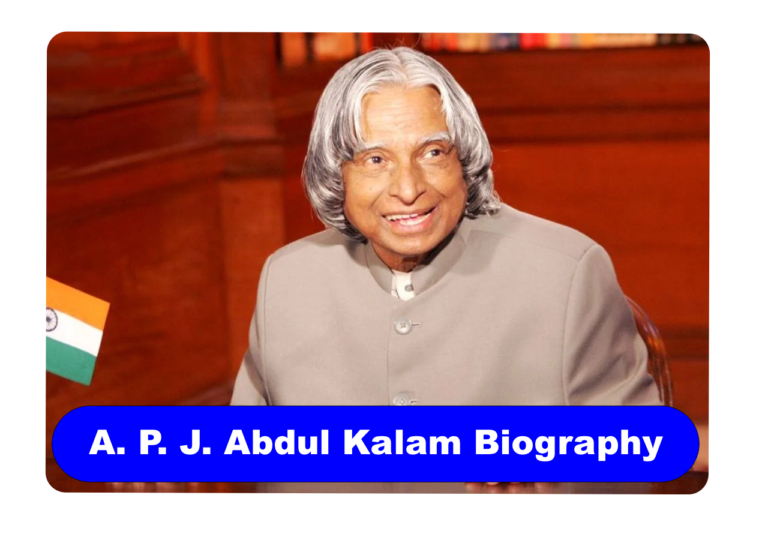
A. P. J. Abdul Kalam was India’s 11th president and Missile Man. Discover his age at death, education, scientific work, books, family and lasting legacy.
A. P. J. Abdul Kalam was an Indian aerospace scientist, author and statesman who served as India’s 11th president from 2002 to 2007. This A. P. J. Abdul Kalam biography follows his journey from a modest childhood in Tamil Nadu to the country’s highest constitutional office. He helped develop India’s satellite launch and missile programmes, earning the nickname Missile Man of India. His warmth toward students also made him widely known as the People’s President.
Born on 15 October 1931, Kalam worked for decades at India’s leading research organisations before entering public office. He received the Bharat Ratna, India’s highest civilian honour, in 1997. He died on 27 July 2015, aged 83, after collapsing while addressing students in Shillong. His writing and advocacy for education continue to influence young readers.
Quick Facts About A. P. J. Abdul Kalam
| Detail | Information |
|---|---|
| Full Name | Avul Pakir Jainulabdeen Abdul Kalam |
| Date of Birth | 15 October 1931 |
| Date of Death | 27 July 2015 |
| Age at Death | 83 years |
| Birthplace | Rameswaram, Tamil Nadu, British India |
| Profession | Aerospace scientist, author and statesman |
| Position | 11th President of India (2002–2007) |
| Parents | Jainulabdeen Marakayar and Ashiamma |
| Wife | Never married |
| Children | None |
| Education | St. Joseph’s College; Madras Institute of Technology |
| Major Award | Bharat Ratna (1997) |
| Known For | ISRO, missile development, presidency and books |
Childhood in Rameswaram and Family Background
Kalam was born into a Tamil Muslim family in Rameswaram, a coastal town now in Tamil Nadu. His father, Jainulabdeen, owned a boat used to transport pilgrims and also served as an imam. His mother, Ashiamma, managed the household. Although the family had a respected place in its community, its finances were limited.
As a boy, Kalam helped distribute newspapers to support the family’s income. He grew up among neighbours of different religions, an experience that shaped his respect for cooperation and understanding. He later described teachers and family members who encouraged his curiosity. Those early influences helped turn an interest in mathematics and flight into a lifelong ambition.
Education and the Dream of Becoming a Pilot
Kalam attended Schwartz Higher Secondary School in Ramanathapuram and developed a strong interest in science. He studied physics at St. Joseph’s College in Tiruchirappalli, graduating in 1954. He then pursued aeronautical engineering at the Madras Institute of Technology. The training gave him practical experience in aircraft design and engineering problems.
He initially hoped to become a fighter pilot in the Indian Air Force. However, he narrowly missed selection, a disappointment he later discussed in his writings. Instead, he began a career in defence research. That change of direction eventually placed him at the centre of India’s aerospace programmes.
Early Scientific Career at DRDO and ISRO
Kalam began his scientific career at the Defence Research and Development Organisation (DRDO), where his work included an experimental hovercraft project. He later joined the Indian Space Research Organisation (ISRO). There, he became project director of the Satellite Launch Vehicle-III (SLV-III), designed to give India an indigenous satellite-launch capability.
The programme faced a setback when its first experimental launch in 1979 failed to reach its intended goal. The team continued working, and on 18 July 1980, SLV-III successfully placed the Rohini satellite into orbit. This marked an important step in India’s independent space capabilities. Kalam often stressed that teamwork, careful testing and learning from failure were essential to engineering success.
Why Abdul Kalam Was Called the Missile Man of India
After his work in space research, Kalam took a leading role in India’s guided-missile development programme. He directed the Integrated Guided Missile Development Programme, which brought together research institutions and technical teams. The programme included missiles such as Agni and Prithvi, helping expand India’s domestic defence technology capabilities.
Kalam later served as scientific adviser to India’s defence minister and as secretary of the Department of Defence Research and Development. He also played a significant role in preparations for India’s Pokhran-II nuclear tests in 1998. Those tests strengthened the government’s stated strategic deterrence goals but also attracted international criticism and sanctions. His defence work made him a prominent national figure before he entered politics.
Presidency from 2002 to 2007
Kalam became India’s 11th president on 25 July 2002, succeeding K. R. Narayanan. Unlike many previous presidents, he came primarily from a scientific rather than a party-political background. He used public appearances to discuss education, innovation and his vision of a more developed India. Frequent conversations with schoolchildren helped popularise the name People’s President.
His presidency was not without difficult constitutional decisions. In 2006, he returned legislation concerning offices of profit to Parliament for reconsideration before later granting assent. The episode highlighted the responsibilities and limits of the presidential office. His five-year term ended on 25 July 2007, when Pratibha Patil succeeded him.
Wife, Children and Personal Life
A. P. J. Abdul Kalam never married and had no children. He maintained close ties with his extended family and was known for a relatively simple personal lifestyle. Even during his years as president, he often preferred discussions about science, education and public service over attention to his private life.
His personal interests included reading, writing and music. He also valued faith and spoke about respect between religious communities. These interests appeared regularly in his public addresses and autobiographical writing.
Popular Books by A. P. J. Abdul Kalam
Kalam wrote books that brought science, leadership and personal development to a general audience. His autobiography, Wings of Fire, written with Arun Tiwari, recounts his childhood and scientific career. In Ignited Minds, he focused on the potential of young Indians. His books encouraged readers to connect personal ambition with wider social progress.
Other well-known titles include India 2020: A Vision for the New Millennium, written with Y. S. Rajan, and My Journey. Across his writing, he returned to education, technology and the possibility of national development. These books remained widely discussed around his 95th birth anniversary in October 2026.
Bharat Ratna and Other Major Awards
Kalam received the Padma Bhushan in 1981 and the Padma Vibhushan in 1990 for his contributions to science and public service. In 1997, India honoured him with the Bharat Ratna, its highest civilian award. He also received honorary doctorates and recognition from universities and scientific institutions in India and abroad. These honours reflected his contributions to research, technology and national development.
Death at IIM Shillong in 2015
On 27 July 2015, Kalam was delivering a lecture at the Indian Institute of Management Shillong in Meghalaya. He collapsed during the address and was taken to a nearby hospital, where doctors declared him dead following cardiac arrest. He was 83 years old. His death prompted widespread mourning across India.
Kalam received a state funeral in his hometown of Rameswaram on 30 July 2015. A national memorial was later established there. The circumstances of his death, while speaking to students, reflected the educational work that occupied much of his later life.
Legacy of India’s People’s President
Kalam is remembered for helping develop India’s technological capabilities and bringing scientific ideas into public conversation. His work on missiles and nuclear testing also remains part of wider debates about national security and the consequences of military technology. Yet his influence extended beyond defence research. For many young Indians, he became a symbol of education, perseverance and service.
Final Thoughts
A. P. J. Abdul Kalam’s biography connects a modest upbringing with major contributions to science and national leadership. He moved from laboratory work to the presidency without abandoning his interest in teaching. His lasting message was that knowledge, hard work and opportunity can change individual lives and help shape a country’s future.
Frequently Asked Questions
Q1: How old was A. P. J. Abdul Kalam when he died?
He was 83 years old when he died on 27 July 2015. He was born on 15 October 1931 and would have turned 95 in October 2026.
Q2: Who was A. P. J. Abdul Kalam’s wife?
Abdul Kalam never married. He had no wife or children.
Q3: Why is Abdul Kalam called the Missile Man of India?
He earned the nickname for his leadership in India’s guided-missile development programme. His work included the development of Agni and Prithvi missile systems.
Q4: When was Abdul Kalam the president of India?
He served as India’s 11th president from 25 July 2002 to 25 July 2007. He succeeded K. R. Narayanan and was followed by Pratibha Patil.
Q5: What are A. P. J. Abdul Kalam’s most famous books?
His best-known books include Wings of Fire, Ignited Minds, India 2020 and My Journey. They cover his experiences, scientific development and ideas for India’s future.
Q6: Which awards did Abdul Kalam receive?
He received the Padma Bhushan in 1981, Padma Vibhushan in 1990 and Bharat Ratna in 1997. The Bharat Ratna is India’s highest civilian honour.
Q7: How did A. P. J. Abdul Kalam die?
He suffered cardiac arrest after collapsing during a lecture at IIM Shillong on 27 July 2015. He died that evening at the age of 83.